
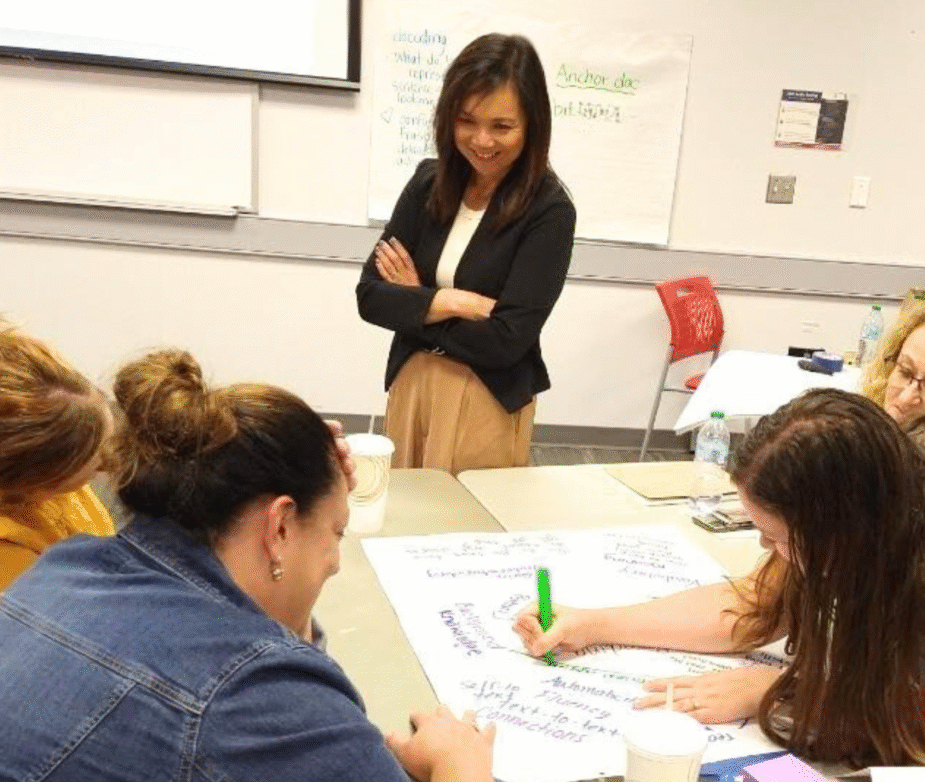
When professional learning starts with empathy, it transforms learning into action.
Key Takeaways
- Professional learning in K-12 education that lasts begins with empathy and inquiry.
- Design thinking keeps learning relevant and educator-centered.
- Reflection and curiosity help translate ideas into practice.
- Consistency and co-creation make learning scalable.
Why Empathy Matters in Professional Learning
Too often, professional learning in K-12 education feels disconnected from the realities of teaching. Educators complete the training, earn the certificate, and return to classrooms unchanged.
For designer and facilitator Myla Lee, effective professional learning starts with empathy. Through the REMC–ALP partnership, she has led hundreds of virtual and hybrid learning experiences, each one designed to reflect what teachers actually need.
“I always start by asking teachers what they need before I start building,” Myla said. “That’s how you design for people, not for process.”
Empathy turns training into collaboration. By treating teachers as co-designers rather than recipients, districts create professional learning that becomes part of daily practice, not just a checkbox.
Using Design Thinking to Improve Professional Learning
Myla’s approach to professional learning is grounded in design thinking—a process that values empathy, curiosity, creativity, and continuous iteration. She doesn’t start with content. She starts with people.
Before building a new course, Myla takes time to empathize with educators by gathering insights from teachers, listening to leaders, and scanning the field for patterns and pain points. “I ask what problems educators are trying to solve right now,” she said. “Once you understand that, the rest of the design starts to make sense.”
Next, she moves into ideation and prototyping, storyboarding course structures and testing small sections with trusted educators before scaling them statewide. Each round of feedback acts as a test phase, revealing what resonates and what needs refinement.
This iterative approach reflects how Rachel Fruin, who leads digital learning initiatives at ALP, describes the broader partnership philosophy: “When professional learning starts with listening, you create something educators want to return to.”
Design thinking helps Myla and the REMC–ALP team create professional learning that adapts as educators’ needs evolve. It’s a cycle of empathy, experimentation, and reflection that keeps learning relevant and human-centered. This same design philosophy drives ALP’s statewide systems work, explored in Building Human-Centered Professional Learning Systems at Scale.
Creating Experiential Professional Learning
For learning to stick, educators have to experience it—not just hear about it. Every course Myla designs includes opportunities to reflect, create, and apply ideas immediately.
She balances challenge and support to create what she calls productive struggle—the right level of difficulty that stretches thinking without overwhelming it.
“If you dedicate time to learning, it should stretch you,” she said.
Her long-running course on inquiry and questioning shows the result. Teachers consistently describe how it reshapes their approach:
“Students need the freedom to explore their own thinking instead of just answering ours.”
Those reflections demonstrate what empathy-driven design can do. A small change in one classroom can create ripples across an entire system—a principle that also underpins the long-term partnership behind this work.
When professional learning starts with listening, you create something educators want to return to.
Myla’s Design Principles for Effective Professional Learning
- Lead with empathy. Start with teacher input to guide design decisions. Myla begins every course by reaching out to educators to understand their realities. “I start by asking teachers what they need before I start building,” she said. “That’s how you design for people.”
- Balance challenge and support. Stretch learners while respecting their time and expertise. Myla builds what she calls productive struggle—the balance between challenge and success. “If you dedicate time to learning, it should stretch you,” she explained.
- Encourage visible reflection. Build space for sharing insights and connecting ideas. Each course closes with a digital “gold nugget” board where teachers post key takeaways and describe how they’ll apply them in their classrooms. “Seeing what others learned helps teachers recognize their own growth,” she said.
- Maintain consistent structure. Predictability helps learners focus on content. Every REMC course follows a clear, repeatable rhythm while leaving space for facilitator creativity. “Every facilitator brings their own magic, but the through line stays consistent,” Myla shared.
- Keep learning human-centered. Tools enhance learning when they serve people’s needs, whether it’s integrating AI, visuals, or discussion prompts. Myla designs for engagement that begins with people. “Technology should make space for deeper thinking,” she said. “The person in the room still matters most.”
Co-Creating Professional Learning With Educators
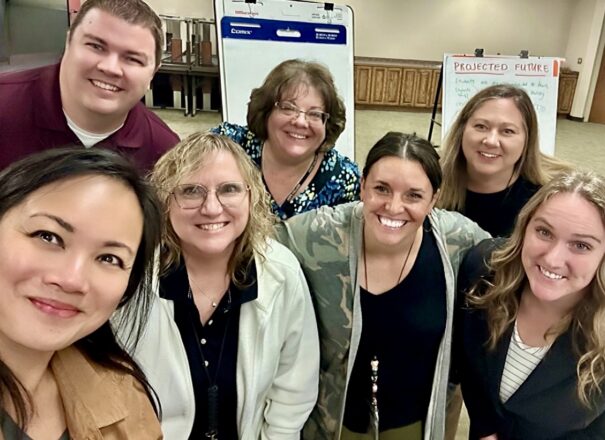
Within the REMC–ALP model, educators help shape the design process itself. Myla gathers feedback throughout each course cycle, adjusts pacing and activities, and tests new ideas with small groups before expanding statewide.
This co-creation process keeps learning relevant—and it’s one reason REMC’s virtual courses maintain an impressive 80 percent completion rate. Educators stay engaged because they see their own input reflected in the design.
As Amos Fodchuk, ALP’s President, put it, “Consistency builds trust, and flexibility keeps people curious.” That balance between structure and creativity is what allows professional learning to scale while staying meaningful.
Technology business collaborations play a crucial role in enabling such professional learning experiences to take place. Working together, Dell Technologies and Michigan-based reseller People Driven Technologies provide competitive pricing to REMC. This allows Michigan districts to purchase laptops and other hardware and software services and to accumulate professional learning days based on these purchases. Those days become the property of REMC and are used strategically to support Michigan educators
Building a Culture of Continuous Learning
What began as one facilitator’s design process has evolved into a statewide culture of empathy-driven learning. Reflection boards, coaching cohorts, and communities of practice all build on the same foundation: professional learning should feel alive, responsive, and personal.
Rachel Fruin sees that impact firsthand. “When teachers have a voice in what they learn, they carry that same empathy into their classrooms,” she said.
The approach this partnership takes values the principles trust, reflection, and shared purpose. Together, they help transform professional learning into a living design that can grow with every educator it reaches.
Professional Learning That Lasts
Professional learning that endures in K–12 education is grounded in empathy, curiosity, and collaboration. When educators have ownership of their growth, they bring that same mindset to their students—and that ripple effect strengthens the entire learning ecosystem.
The REMC–ALP partnership shows what happens when professional learning is designed with educators, not for them. Trust, reflection, and shared purpose have turned individual courses into a culture of continuous improvement that keeps teachers connected and inspired.
As Myla reflected, “When we design with people in mind, the learning will always matter.”
That idea echoes across the full series—from building long-term partnerships that foster trust, to designing professional learning experiences that stick, to creating scalable systems that grow alongside educators. Together, these stories illustrate how empathy and collaboration can sustain meaningful learning at every level.
This blog is part of a three-part series exploring lessons from a statewide professional learning partnership. Read the other stories on Building Partnerships That Last and Building Human-Centered Professional Learning Systems at Scale. All three draw from the case study Scaling Meaningful Professional Learning for Educators Across Michigan.
