
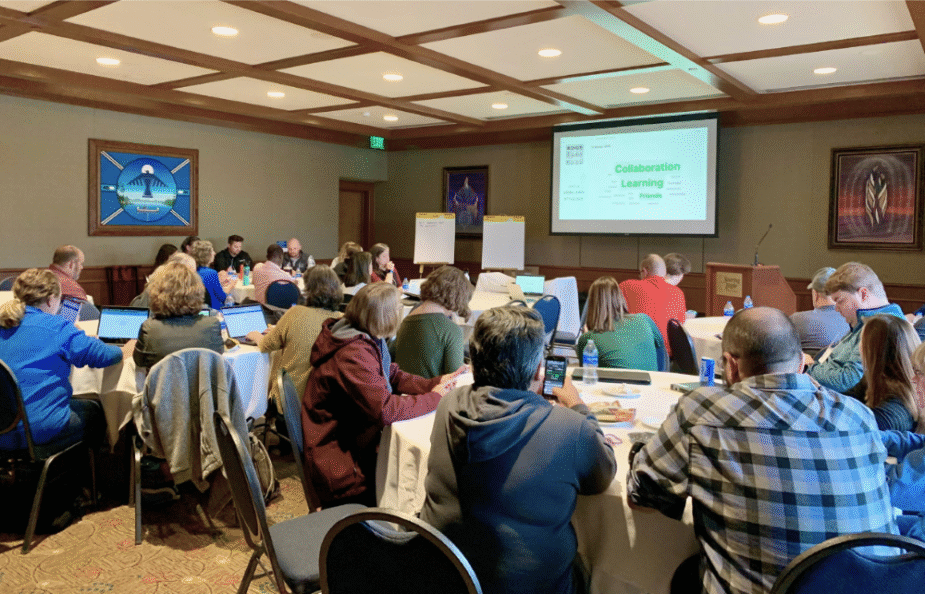
How a shared commitment to reflection, respect, and challenge helped transform a partnership into a statewide model.
Key Takeaways
- Long-term K-12 partnerships thrive on curiosity, challenge, and shared goals.
- Productive disagreement strengthens innovation and trust.
- Reflection cycles and role clarity sustain collaboration over time.
- Mutual respect allows each partner to lead with its strengths.
How Long-Term Partnerships Strengthen Professional Learning
Few K-12 education partnerships last more than a few years. The collaboration between Advanced Learning Partnerships (ALP) and the Regional Educational Media Center Association of Michigan (REMC) has lasted over a decade — and continues to evolve.
This partnership’s success stems not from contracts or convenience, but from shared purpose, complementary strengths, and a willingness to challenge one another toward better outcomes.
Melinda Waffle, who has helped guide this partnership from its early years, attributes its longevity to deep mutual respect. “Each organization knows the other’s gifts,” she explains. “We both understand what we bring to the table and what we’re here to accomplish together.”
The Foundation of a Strong Education Partnership
When the partnership began, REMC’s statewide K-12 network provided access and infrastructure, while ALP contributed human-centered design expertise and a commitment to teacher-centered professional learning. Together, they built a system that could grow without losing its connection to educators.
That alignment was intentional. REMC’s strength lies in its statewide reach and local leadership; ALP’s lies in its ability to design professional learning that feels personal, relevant, and replicable. The partnership merged those capabilities to support educators in every corner of the state.
Technology business collaborations play a crucial role in the partnership by providing a sustained structure for reinvestment. Dell Technologies and Michigan-based reseller People Driven Technologies work together to provide competitive pricing to REMC. Their bids and value-add allow competitive pricing that helps Michigan districts purchase laptops and other hardware and software services. Professional learning (PL) days are accumulated based on these purchases, and the corresponding PL days become the property of REMC and are used strategically to support Michigan educators.
How Collaboration and Challenge Build Better Partnerships
Sustained collaboration doesn’t mean constant agreement. In fact, productive tension has been one of the REMC–ALP partnership’s greatest strengths.
Melinda describes this as a defining feature: “Respect plus productive disagreement equals stronger design.”
Some of those early challenges — like how to integrate emerging technologies responsibly — became new opportunities for innovation. Districts exploring generative AI have faced similar moments of productive struggle that ultimately strengthen learning systems.
Amos Fodchuk, ALP’s Founder and President, echoes this philosophy in describing the partnership’s “visioning cycles,” where teams regularly evaluate priorities. Some ideas evolve, others fade, and some — like statewide virtual courses and AI literacy cohorts — become flagship initiatives. “A few of our best projects began as bold ideas that challenged our original assumptions,” Amos reflects.
Even when something doesn’t go as planned, we look for the learning in it. Those conversations turn mistakes into momentum.
Best Practices for Sustaining Education Partnerships
The REMC–ALP model shows that longevity in partnerships comes from intentional design and shared reflection. For education leaders looking to sustain meaningful collaboration, these lessons come to life through the people who help shape them. Myla Lee, a longtime facilitator within the partnership, has seen how structure, trust, and curiosity keep the work evolving. Together, her experiences and the team’s shared practices offer a roadmap for sustaining impact over time.
Create regular reflection cycles. Strong partnerships make time to step back, review, and adapt. ALP and REMC revisit every initiative through a structured reflection process, usually every three years. Myla sees this as an opportunity to renew purpose and relevance.
“Courses have an expiration date,” she explained. “Every three years we revisit the content, test it, and decide whether to revise, retire, or redesign. That reflection ensures the work stays aligned with what teachers need right now.”
Define roles, not territories. Clear roles build trust and make room for creativity. REMC and ALP outline who leads, who supports, and how decisions are shared. Myla has experienced how that clarity invites contribution.
“They let us have a voice,” she said. “That trust and flexibility tell me my perspective matters, and that helps the work grow.”
Document and celebrate learning. Each cycle of work leaves a record of insight that guides the next one. The partnership documents course data, facilitator reflections, and participant feedback to inform future designs. Successes are shared and challenges are used as fuel for improvement.
“Even when something doesn’t go as planned, we look for the learning in it,” Myla said. “Those conversations turn mistakes into momentum.”
Keep curiosity alive. Partnerships thrive when curiosity stays at the center. For ALP and REMC, curiosity shows up in open dialogue, piloting new ideas, and creating space for different perspectives. As Melinda Waffle shared, “Challenge is a form of collaboration.”
That mindset keeps the partnership dynamic. Each year, new initiatives—like statewide AI literacy cohorts—emerge from that same culture of questioning and trust. Curiosity has become both the fuel and the framework for sustainable collaboration.
Why Long-Term Partnerships Matter for Professional Learning Systems
Sustaining a partnership over a decade is more than just an operational achievement; it’s a learning strategy. The REMC–ALP collaboration proves that long-term alignment builds institutional memory, strengthens design quality, and enables true systems-level change.
Rachel Fruin, Director of Professional Learning, sees that evolution as essential. “When partners commit for the long haul,” she explains, “they can focus on learning, not just launching. That’s when the work starts to make a real difference.”
Long-term collaboration builds the kind of trust and connection that leaders need to navigate change — a reminder that even in a digital world, in-person connection for education leaders still drives the most meaningful learning.
This blog is part of a three-part series exploring lessons from a statewide professional learning partnership. Read the other stories on How to Design Professional Learning That Sticks and Building Human-Centered Professional Learning Systems at Scale. All three draw from the case study Scaling Meaningful Professional Learning for Educators Across Michigan.
