
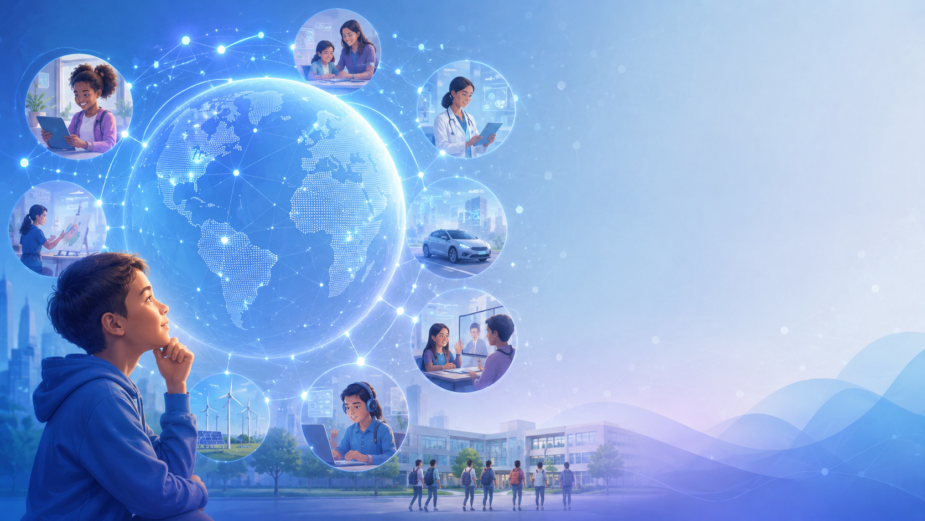
ALP partnered with Virtual Virginia and the Virginia Association of School Superintendents (VASS) to develop beginner, intermediate, and advanced-level AI literacy courses for teachers across Virginia. This blog is the second in a series highlighting content that was created for these courses. We believe that AI literacy includes knowing how to use tools safely, responsibly, and effectively, and understanding how AI impacts the world around us. This content dives deep into the impact of AI through the lens of curricular subjects.
Where did AI already shape your day before lunch?
AI is already deeply embedded in everyday life, often in ways that feel ordinary or invisible. Many people interact with AI through healthcare systems (such as appointment scheduling, diagnostic support, or medical imaging analysis), shopping and commerce (product recommendations, dynamic pricing, fraud detection), and personal devices (voice assistants, predictive text, facial recognition, navigation, and smart home features). These systems rely on data, patterns, and algorithms to support decisions, streamline services, and personalize experiences. Understanding AI’s visible and invisible forces in the world makes us informed global citizens. This durable skill often appears in a school district’s portrait of a graduate or learner profile.
The broad topic of AI is ripe with relevant curricular connections and presents a great opportunity for teachers to introduce AI to their students. These examples do not require teachers or students to use AI for teaching and learning. Instead, they help teachers connect their content with AI and students’ lived experiences.
AI and the Environment
The news is filled with headlines about the impact of AI on the environment. Students (and teachers!) may be interested to learn that many tasks in our daily lives, like streaming a movie, scrolling social media, or joining a Zoom call, require more energy from a data center than simply writing an AI prompt.
Science class is a great place to study the impact of AI on the environment. Conversations often center around the electricity and water required to run data centers. A less discussed impact is the mining of materials like rare earth elements mined for their special electromagnetic, thermal, optical, and magnetic properties. (Note: there is also a social studies connection here, because of where these rare earth elements are in the world, and the politics involved in acquiring them.) Rare earth elements are used for servers, networking equipment, storage drives, cooling systems, and more.
Science teachers can guide their students to explore this impact by learning about the world’s energy sources and usage. And they can talk about ways to reduce the data center impact across all our internet usage, not just AI.
Big Data and the Algorithms that Generate AI Outputs
Consider how often you hear phrases like “The algorithm gave me…” or “AI learned from millions of examples.” What do those statements actually mean? Big data and algorithms create an entry point for math teachers to talk about AI with their students. Big data often represents people’s behaviors, choices, and environments—but always imperfectly. These datasets often include information generated by people (texts, images, clicks), devices (sensors, phones), institutions (schools, hospitals), and digital platforms. Some groups are overrepresented, others underrepresented, and many human qualities cannot be captured at all. Meanwhile, AI algorithms use patterns in data to make predictions, recommendations, or classifications based on this imperfect data.
One main idea of AI literacy is that AI doesn’t “think”; it generates probable answers. Mathematics is behind AI outputs that sound reasonable. Understanding big data helps students question claims made by AI systems, recognize bias and gaps in data, and remember that humans remain responsible for decisions made with data‑driven tools.
Innovation and Government Regulation
AI is growing rapidly. If technology moves faster than the law, who is responsible for protecting people in the meantime? Social studies teachers have the opportunity to use the current events of AI growth to talk about historical innovations that led to regulation and/or how the government works to pass laws around AI, such as data privacy, consumer protection, and deepfake laws.
Consider the historical example of aviation. Early flight advanced rapidly before safety standards existed. Crashes and public concern led to air traffic control systems, pilot licensing, and aircraft safety regulations that ultimately increased public trust and expanded air travel. Pharmaceuticals are another innovation that grew quickly and needed consumer protection. Many early medicines entered the market with little oversight. Public health crises prompted the creation of regulatory bodies, clinical trials, and approval processes designed to protect people while still enabling medical innovation.
Helping students understand how AI is governed, who is responsible for its use, and why guardrails exist prepares them to navigate AI systems critically and responsibly beyond school.
AI, Authorship, and Intellectual Property
English Language Arts teachers are legitimately concerned about how access to and use of AI can lead to cognitive offloading of the writing process, of which the impacts haven’t been thoroughly researched or felt at this point. Instead of introducing AI to the students as a tool to use for their work, teachers may feel more comfortable beginning to build literacy through curricular topics like authorship, copyright, and intellectual property. Writers in Hollywood have publicly challenged the use of AI to generate scripts, arguing that such tools threaten both authorship and livelihoods. Authors and journalists have also raised concerns that their books, articles, and other written works were used to train AI systems without permission, compensation, or meaningful transparency.
In this context, English instruction can help students examine how writing, creativity, and ownership are changing in a world where text can be generated quickly, fluently, and at scale.
AI and the Future of Work
Career and Technical Education sits at the intersection of tools, technology, and workforce readiness. Across industries, AI is becoming embedded in diagnostics, logistics, design, safety systems, predictive maintenance, precision agriculture, financial modeling, and customer interaction. CTE teachers might not be able to predict how careers will change because of AI in 5-10 years. But they can help their students explore the impact AI is making on different career pathways today. This kind of literacy helps students make informed decisions about jobs and the learning they need to pursue their goals.
AI and Mental Health
What happens when tools designed for efficiency begin to shape identity, self-worth, or attention? As AI systems become more conversational and emotionally responsive, some students and adults have experienced serious challenges related to over‑reliance on AI for validation, companionship, or decision‑making. This topic is an important one to be discussing with students, particularly in the context of health and physical education.
Districts across the U.S. are piloting or using a growing range of AI‑enabled mental health and wellness tools. Potential benefits cited by developers and school leaders include expanded access to support, faster identification of students who may need help, and reduced strain on overextended counseling staff. However, professional organizations and researchers caution that these tools also introduce significant risks, including over‑reliance on automated responses, false reassurance, misclassification of student needs, data privacy and consent concerns, and the replacement of human relationships with simulated support.
Artistic Expression, Creative Labor, and AI
Teaching about AI in the fine arts is not about treating AI as a neutral innovation or encouraging students to outsource artistic work. Instead, it offers a powerful opportunity to help students examine what art is for, what makes expression meaningful, how creative traditions change over time, and how technology can reshape both opportunity and harm. Fine arts classrooms are uniquely positioned to ask not only what a work communicates, but also how it was made, whose labor is involved, whose style or voice may have been imitated, and what is gained or lost when machines participate in creative production.
One important entry point is the idea that art has always been shaped by forces outside the artist. New technologies, government policies, economic changes, religious movements, and cultural shifts have repeatedly changed what artists make, how they make it, and who gets access to creative work. AI belongs in this longer history. Understanding that history helps students see that the current moment is not entirely new, even if the technology is.
Teachers are feeling overwhelmed and hesitant about AI in education. There are legitimate reasons for these feelings. Connecting ideas about a new technology to subject matter expertise makes professional learning more intentional and relevant. If your staff would be interested in diving deeper into these curricular connections of the impact of AI on our world, ALP would love to help. We’ve created lesson plan ideas at the K-2, 3-5, 6-8, and 9-12 grade levels to help all teachers across subject areas see the connection of AI to their curriculum. Let ALP help your district equip educators with AI literacy through relevant, competency-based, professional learning courses.
AI Transparency Statement: AI was used to draft parts of this blog with provided research and context. AI-generated text was edited by the author.
References
- American Psychological Association. “Teens, Chatbots, and Parents.” APA Topics: Artificial Intelligence & Machine Learning, https://www.apa.org/topics/artificial-intelligence-machine-learning/teens-chatbots-parents
- Baird, A., & Schuller, B. (2020). Considerations for a More Ethical Approach to Data in AI: On Data Representation and Infrastructure. Frontiers in Big Data, 3. https://doi.org/10.3389/fdata.2020.00025
- Coggan, Georgia. “How the Bionic Awards Shifted My View on AI Filmmaking.” Creative Bloq, 17 Apr. 2026, https://www.creativebloq.com/ai/the-bionic-awards-changed-my-view-on-ai-filmmaking
- “Data-Center and AI Energy Analyses.” International Energy Agency (IEA), 2025, https://www.iea.org/reports/data-centres-and-energy
- “Explained: Generative AI’s Environmental Impact.” MIT News, Massachusetts Institute of Technology, 2025, https://news.mit.edu/2025/explained-generative-ai-environmental-impact-0117
- Frontiers in Big Data. (2025). Bias in AI systems: integrating formal and socio-technical approaches. Frontiers in Big Data. https://doi.org/10.3389/fdata.2025.1686452
- Ippolito, Jon. “AI in Education #AILiteracy #AIEthics.” LinkedIn, 2025, https://www.linkedin.com/posts/jonippolito_aiineducation-ailiteracy-aiethics-share-7365730024924127233-5V0A/?utm_source=share&utm_medium=member_desktop&rcm=ACoAAAeA3-kBJck7QB2SkMWLmjp3JZTbjwYuGos
- Killion, Victoria L. The TAKE IT DOWN Act: A Federal Law Prohibiting the Nonconsensual Publication of Intimate Images. Congress.gov, Congressional Research Service, 20 May 2025, https://www.congress.gov/crs-product/LSB11314#:~:text=On%20April%2028%2C%202025%2C%20Congress,deepfakes)%2C%20in%20certain%20circumstances
- RE100 and Vendor Sustainability Reports (Google, AWS, Microsoft). The Climate Group and CDP, 2025, https://www.there100.org
- “The Hidden Environmental Impact of Large-Scale AI.” NexGen Cloud Blog, 2024, https://www.nexgencloud.com/blog/thought-leadership/the-hidden-environmental-impact-of-large-scale-ai
- World Economic Forum. The Future of Jobs Report 2025: Infographics. World Economic Forum, 7 Jan. 2025, https://www.weforum.org/publications/the-future-of-jobs-report-2025/infographics-94b6214b36/
