
There’s a persistent narrative in education that meaningful change is slow, fragile, and dependent on isolated innovators.
That narrative is increasingly out of date.
Across Virginia, what’s emerging is not a collection of promising pilots—it’s a coordinated shift in how school systems, industries, and communities define their shared responsibility for preparing young people. And it’s happening faster than most people realize.
At a recent event in Richmond, the conversation wasn’t about whether students should pursue college or careers. That debate still shows up in language, but in practice, many communities have already moved past it. The real question now is whether we are willing to redesign systems to reflect that both pathways—and the fluid movement between them—are essential.
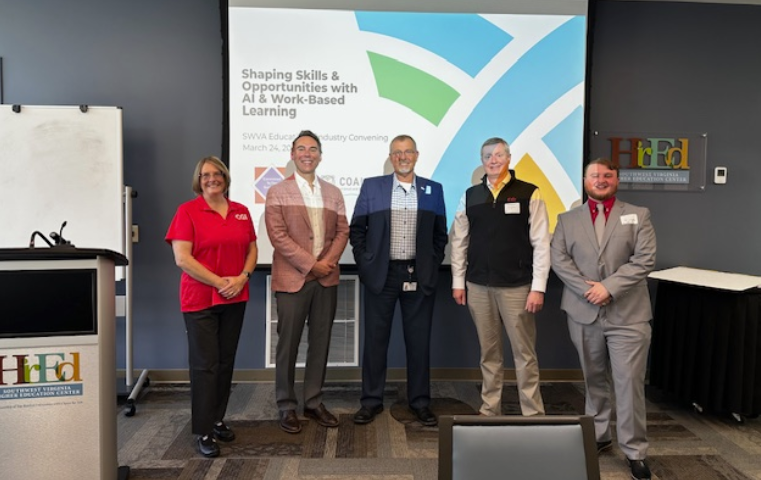
What I witnessed in Southwest Virginia pushed that question further. During the Southwest region symposium, K-12, higher education and industry leaders didn’t sit on panels talking past each other. They worked side by side, examining how AI is already reshaping local work and what that demands of schools. The takeaway wasn’t a list of tools. It was a focused call to action:
- Washington County Public Schools Superintendent Keith Perrigan and CGI Vice President Bruce Crowder announced a new phase of their K-12 industry partnership.
- Executive Director David Matlock committed to hosting a AI & CTE Summit later this spring at the Southwest Higher Education Center.
- Jenny Nichols pledged the full resources of the Higher Ed Center toward the expansion of apprenticeship programs available to all students in Region 7 K-12 divisions.
- Theresa Burriss, who highlighted the research that shows recovering addicts possess a greater likelihood of success as entrepreneurs and what that means for deep community engagement. And Jon Dance, Ph. D candidate at Virginia Tech and entrepreneur, who had the courage to share his pathway to recovery through his business.
All this in a 2.5-hour work session!
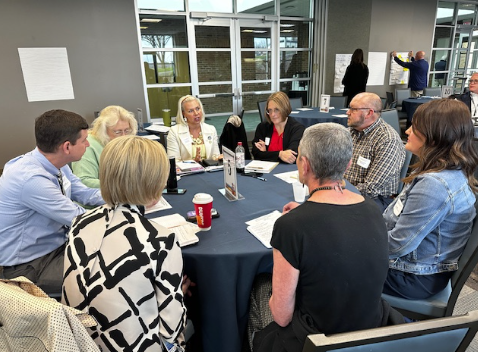
Instead of retreating into incremental adjustments, these communities are doing something more ambitious. They are designing regional networks—shared systems that expand access to real-world learning across divisions.
Not pilots. Not programs.
Infrastructure.
That distinction matters. Because isolated innovation does not scale. Networks do.
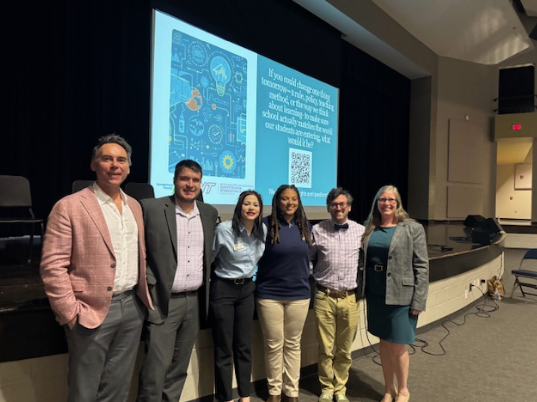
Later that evening in Blacksburg, that same shift showed up in a different form.
Students moved through CTE spaces that felt less like electives and more like entry points into real professions. The panel that followed didn’t center adult interpretation—it surfaced student voice, industry expectations, and the friction points that still exist between school and work.
And here’s the uncomfortable truth that kept surfacing:
We already know what works.
Students learn more deeply when their work is connected to real problems. Agency increases when students have a say in their pathways. Employers are ready—and often eager—to partner more directly with schools.
What we have lacked is not knowledge. It is organization.
Virginia communities are beginning to close that gap. They are moving from alignment in principle to alignment in structure—across K–12, higher education, and industry. When that happens, the ceiling changes. Opportunities that were once limited to a handful of students become available at scale.
This is where the conversation sparked by Multiple Choice—and now Aftermath—becomes more than inspiration.
It becomes a forcing function.
Once communities see what’s possible, the tolerance for the status quo drops.
The question is no longer whether transformation is possible. It becomes how long we’re willing to wait before organizing for it at the level it actually requires.
