Across school communities, conversations about artificial intelligence are becoming more urgent—and more complicated. A recent Pew Research Center study (2026) underscores just how quickly AI has become part of students’ everyday lives: 64% of U.S. teens report using AI chatbots, and more than half say they have used them for schoolwork. At the same time, teens themselves recognize the tensions surrounding that use—59% say AI-enabled cheating occurs at least somewhat often in their schools, while concerns about overreliance and the loss of critical thinking and creativity emerge among those who view AI’s impact negatively. These findings reinforce an important reality for school systems: AI is already present in students’ learning experiences, making clear guidance, intentional instruction, and responsible implementation increasingly important.
Students’ families are asking understandable questions about student safety, privacy, academic integrity, screen time, and the role technology should play in teaching and learning. At the same time, educators and district leaders are already encountering AI in classrooms, employee workflows, communications, and operational systems.
The challenge for districts is no longer whether AI will affect education. The challenge is how to respond thoughtfully, responsibly, and in ways that reflect local values. For many school systems, that work is still in its early stages. AI guidelines may be emerging, but they are often disconnected from a broader vision for teaching, learning, employee practice, governance, and community communication.
That is where a district AI Implementation Plan can make a meaningful difference.
A Plan Creates Clarity and Builds Trust
A strong AI implementation plan gives a district something concrete to stand behind.
Rather than reacting to each new AI tool, concern, or classroom question individually, district leaders can articulate a shared vision for what responsible AI use should look like. That vision can place student learning, safety, equity, privacy, human relationships, and professional judgment at the center.
Importantly, the planning process should not happen to district leaders. It should be designed with them.
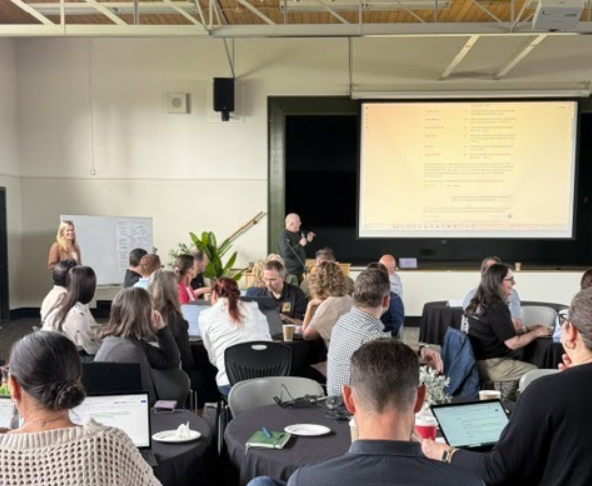
That principle shaped our recent work with seven Vancouver Island school districts: Greater Victoria, Nanaimo-Ladysmith, Qualicum, Gulf Islands, Sooke, Comox Valley, and Campbell River. Together, district leaders participated in a Community of Practice designed to move each system from early exploration toward a clear and measurable roadmap for responsible AI implementation. The work spanned three months and resulted in aligned goals, objectives, KPIs, strategies, and tactics to guide the district’s next phase of AI integration.
The Value of Designing Together
One of the most powerful features of the Vancouver Island work was the opportunity for district leaders to learn and design alongside peers from neighboring systems.
During the onsite design days, leaders worked across district boundaries while still developing plans tailored to their own local context. They explored possibilities for AI integration, clarified shared strengths and values, developed strategic goals, and gathered feedback from colleagues through structured collaborative activities.
That cross-district structure became especially valuable when leaders worked with colleagues in similar roles and portfolios. On the second onsite day, participants collaborated with role and department counterparts from other districts to refine district-specific objectives and move their AI implementation plans forward. For a superintendent, HR leader, technology leader, instructional leader, communications lead, or operations administrator, there is tremendous value in sitting beside and navigating the complexity of AI integration with someone carrying similar responsibilities in another district.
Instead of designing in isolation, leaders can ask:
- How are you approaching this?
- What risks are you anticipating?
- Where could AI meaningfully improve your team’s work?
- What guardrails are you considering?
- What does this look like in your department?
Those conversations accelerate learning while still preserving local decision-making. They help leaders see possibilities they may not have identified on their own, test assumptions, and learn from peers facing many of the same organizational challenges and opportunities.

Building District Capacity – Not Just Producing a Plan
The Community of Practice also created an important balance between regional learning and district ownership.
Most of these districts’ core AI Leadership Design Teams included leaders from human resources, communications, inclusive education, instruction, information technology, finance, Indigenous education, operations, and the superintendency. After onsite sessions, that team continued the work remotely with ALP consultants and brought additional subject-matter experts into the process to build AI implementation strategy and action items in the context of specific departmental repsonsibilities, team processes, and community needs.
The result was more than a planning document. The design experience itself built leadership capacity, strengthened collaboration across departments, and helped position the district to lead AI implementation in ways that are responsible, human-centered, equity-focused, and connected to student learning and district priorities.
That capacity building matters because AI implementation is not a one-time technology initiative. The tools will continue to change. District leaders need the confidence, shared language, governance structures, and decision-making processes to continue adapting long after the initial plan is completed.

From Onsite Visioning to an Actionable Roadmap
The Vancouver Island design process intentionally moved from broad aspiration toward increasingly concrete implementation decisions.
During onsite work, leaders engaged in Human Intelligence (HI)–AI collaborative design cycles to clarify what they wanted AI integration to accomplish across four interconnected areas: students, staff, systems, and community.
The work then continued through remote, department-specific goal groups. Leaders used structured writestorming, workflow discussions, use-case exploration, and AI-supported synthesis to refine objectives and strategies into actionable building blocks for their district plans. The Community of Practice was further supported by a leadership learning series addressing areas including AI guidelines and governance, data systems and communications, AI integration in teacher and principal roles, and workplace wellbeing and AI.
This combination matters: districts are not simply asked to write strategy. Leaders are simultaneously building the knowledge they will need to implement it.

Deliverables that Help Move the Work Forward
The design process culminates in practical tools that help district teams communicate the vision, guide implementation, and measure whether their efforts are making a difference.
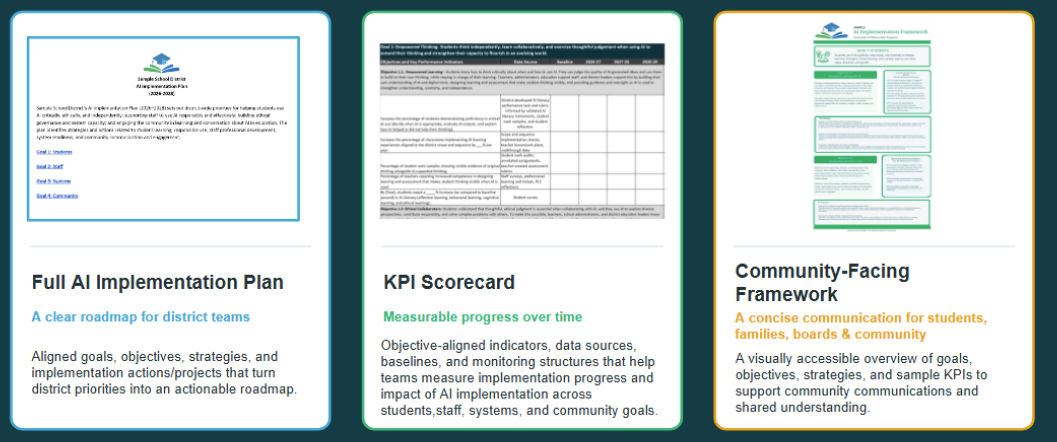
Each district receives a Full AI Implementation Plan that translates its priorities into aligned goals, measurable objectives, strategies, and implementation actions. The full plan is a comprehensive road map for employee leaders and teams charged with implementing strategy and monitoring progress over the course of the plan. A community-facing framework distills work into a clear and accessible story that can be shared with boards, employees, students, families, and community partners—making the district’s values, priorities, and expectations for responsible AI use visible.
But a roadmap alone is not enough. Districts also need data to understand where they are starting, determine where support is most needed, and demonstrate progress over time.
ALP’s AI Implementation Readiness Survey and Reporting provides that baseline. Role-based survey data can illuminate current AI use, readiness, guidance, support needs, and emerging practices across academic and operational teams. Interactive dashboard reporting allows district leaders to examine patterns by role and workflow—for example, how teachers are using AI in instruction and administrative work, how school leaders are integrating AI into leadership functions, or where operational teams see opportunities for AI-supported workflows.
That readiness data then works in tandem with the district’s KPI Scorecard. Objective-aligned indicators, data sources, baselines, and targets create a practical structure for monitoring progress toward the outcomes identified in the AI Implementation Plan.
Together, the survey, dashboard, and KPI scorecard create an ongoing cycle of improvement:
Establish the baseline → Inform implementation priorities → Measure progress → Refine strategies → Demonstrate impact.
Rather than relying on anecdotes about whether AI implementation is “working,” district leaders can use evidence to make decisions about professional learning, governance, approved tools, workflow redesign, instructional support, and other implementation investments. Repeating key measures over time also gives districts a way to demonstrate to employees, boards, families, and communities how responsible AI implementation is evolving—and whether it is producing the outcomes the district set out to achieve.
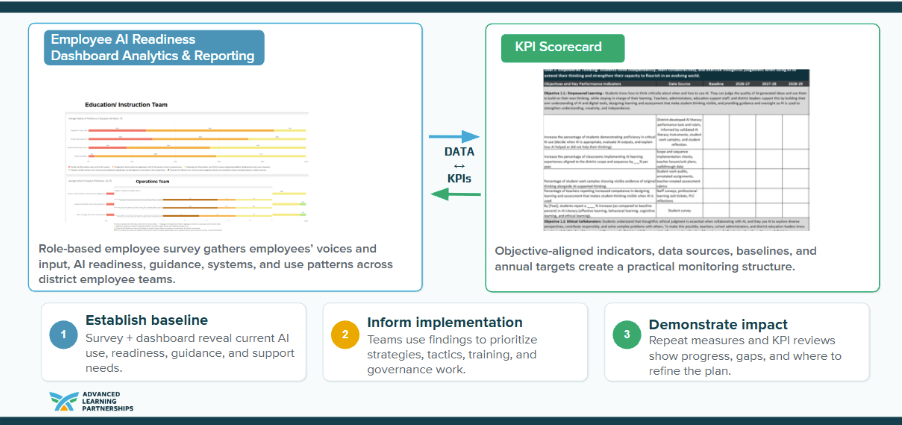
This connection between plan, data, action, and measurement is what turns an AI strategy from a static document into a living implementation system.
From Anxiety to Confidence
A district cannot eliminate every concern about AI – and it should not try to. Healthy questions about privacy, student safety, human relationships, equity, and the appropriate role of technology deserve serious attention.
But uncertainty is much harder for a community to navigate when there is no visible plan.
A thoughtful AI Implementation Plan gives districts a way to say:
- Here is what we believe.
- Here is what we are trying to improve.
- Here is how we will protect students.
- Here is where human judgment remains essential.
- Here is how we will measure whether our strategies are working.
- And here is how our community will know where we are headed.
The experience of the seven Vancouver Island districts demonstrates another important lesson: districts do not have to figure all of this out alone. When leaders have the opportunity to design with their own teams, learn alongside role counterparts in other systems, and translate shared learning into locally owned strategies, AI planning becomes more than a response to new technology.
It becomes an opportunity to build leadership capacity, strengthen collaboration, clarify community values, and create a responsible path forward for student learning in the age of AI.

Reference
Pew Research Center. (2026, February 24). How teens use and view AI. Pew Research Center Internet & Technology
By: Katy Fodchuk, Ph.D. and Yumna Ahmed
