
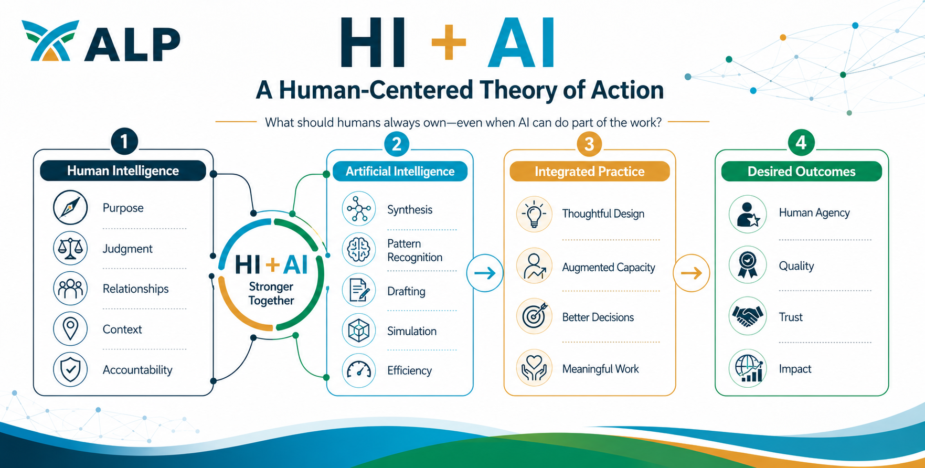
AI adoption is outpacing many organizations’ efforts to define what humans must continue to own. ALP is beginning to develop an HI + AI framework grounded in human purpose, judgment, relationships, agency and accountability.
AI should not merely accelerate work. It should create greater capacity for the work only humans can do.
Artificial intelligence is entering education and organizational life faster than most institutions are defining the conditions for its responsible use.
Teams are experimenting. Workflows are changing. Tools are appearing unannounced inside platforms people already use. Activities that once required hours can sometimes be completed in minutes.
That creates legitimate possibilities for greater responsiveness, creativity and strategic capacity. But it also creates a more consequential question:
What should humans always own—even when artificial intelligence can perform part of the work?
At Advanced Learning Partnerships, we believe this question must sit near the center of any serious approach to AI.
The future of educational work should not be determined only by what technology can produce efficiently. It should be shaped by what students, educators, leaders and communities need—and by the forms of human intelligence required to serve them well.
That is why ALP is beginning to develop an HI + AI framework and toolkit: a practical approach to combining human intelligence and artificial intelligence in ways that strengthen quality, agency and professional responsibility.
This work is emerging from our own experience. ALP has navigated substantial organizational change, evolving client expectations and rapidly developing technologies while continuing to support school systems across the United States and Canada.
We are privileged to learn alongside the partners we serve. Our responsibility is to apply these principles within our own organization, examine the results honestly and share what we learn transparently.
“Human in the loop” Is Not Enough
Much of the current conversation about responsible AI emphasizes keeping a “human in the loop.
”That is necessary—but insufficient.
A person can technically remain in a workflow while exercising very little genuine judgment. Someone may receive an AI-generated document, scan it quickly, correct a few phrases and approve it. A teacher may review automatically generated feedback. A leader may accept an AI-produced analysis without interrogating its assumptions.
The human was present. But did the human truly own the work?
Meaningful human agency requires more than final approval. People must establish the purpose, define the criteria, understand the context, interpret uncertainty and remain accountable for the consequences.
The central question is therefore not:
Where should we insert a human review step?
It is:
Which responsibilities require human intelligence from the beginning—and throughout the process?
What We Mean by HI + AI
Before defining how AI can add value, we need to be explicit about what must remain distinctly human. These capacities are not residual skills left over after automation; they are the sources of purpose, legitimacy and responsibility in the work. They shape how we interpret context, exercise judgment, build trust, care for others and remain accountable for decisions that affect people and communities.
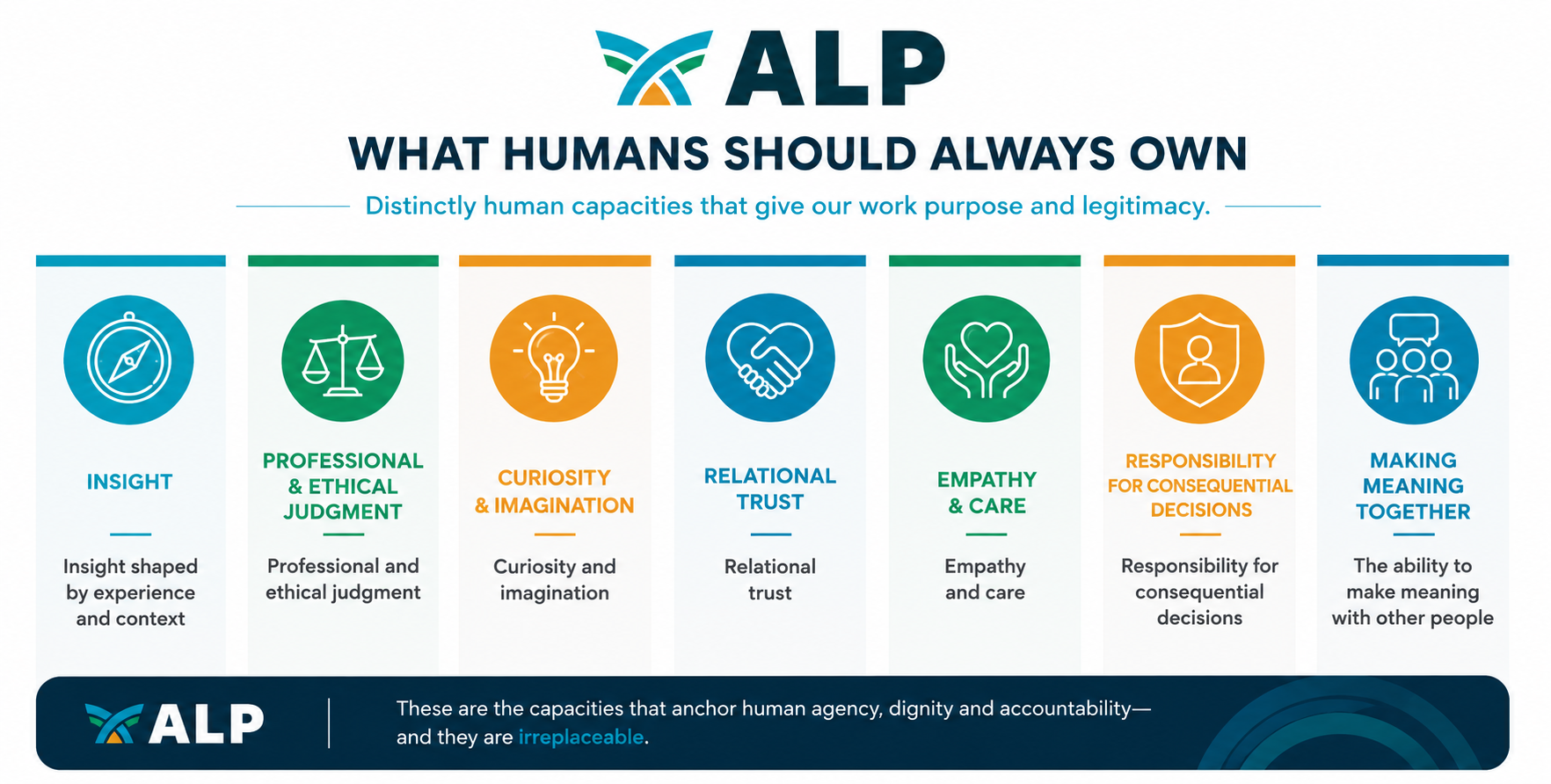
Once those human responsibilities are clear and protected, AI can be applied more deliberately. Its strongest contribution is not replacing professional expertise, but extending capacity: helping people organize complexity, identify patterns, generate possibilities, accelerate early-stage work and make useful knowledge more accessible. The value appears when these efficiencies create more time and attention for the human work that matters most.
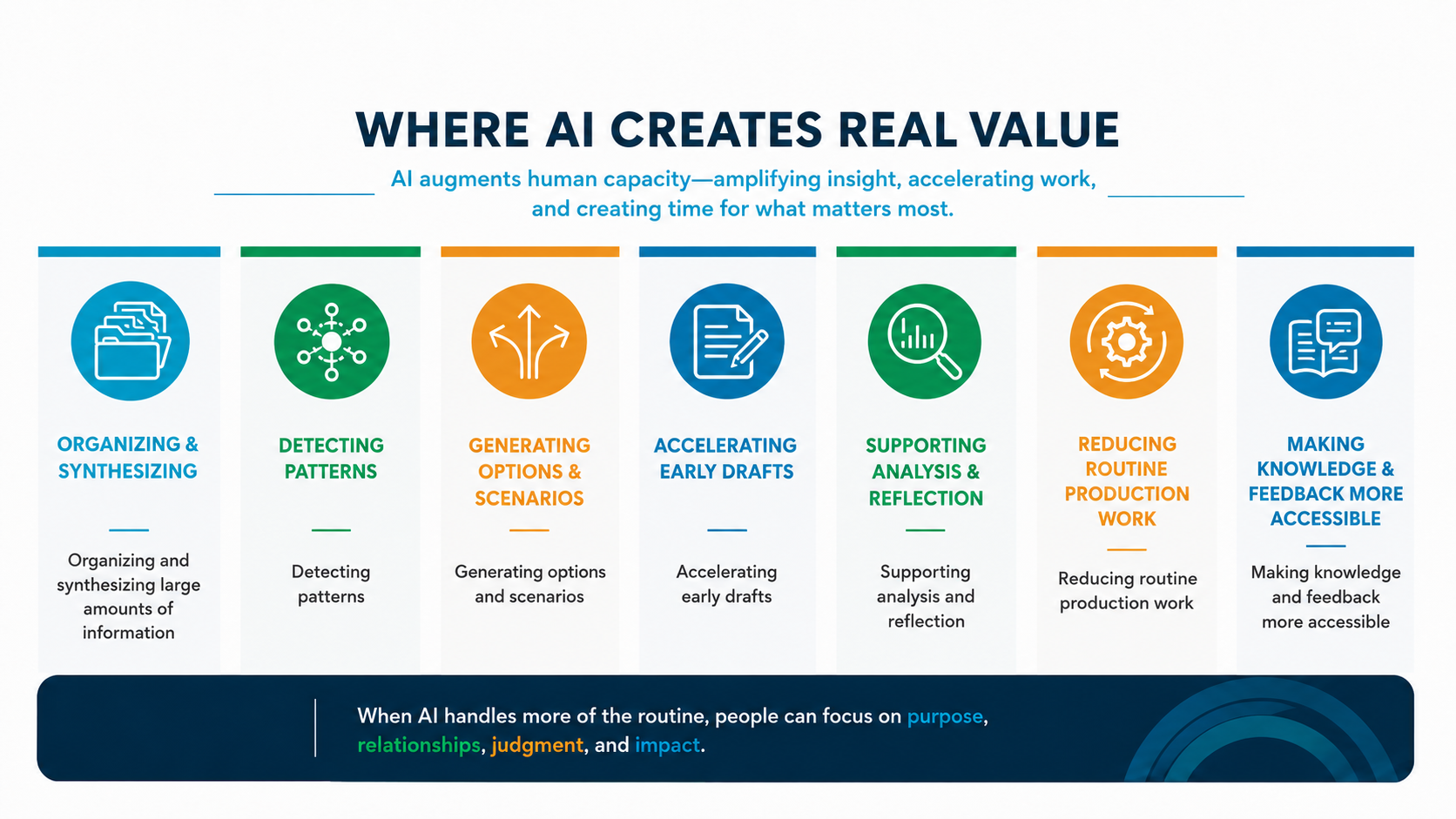
These capabilities can complement one another. But that plus sign is much more than symbolic.
HI + AI is not shorthand for replacing human work with faster machine output. It represents an intentional partnership in which technology expands human capacity while people retain agency over purpose, quality and impact.
What Should Humans Always Own?
Our framework is still developing, but several responsibilities appear foundational:
Humans should own purpose
- AI can help execute an assignment. It cannot determine why the assignment deserves to exist.
- Educators and leaders must decide what the work is intended to accomplish, whom it should benefit and how it connects to broader values and commitments.
- Efficiency without purpose simply allows an organization to move in the wrong direction faster.
Humans should own consequential judgment
- AI can organize evidence and surface possibilities. It should not be treated as independently accountable for decisions affecting students, employees, families or communities.
- People must interpret evidence, recognize its limitations and accept responsibility for the decisions that follow.
Humans should own relationships
- Learning, leadership and organizational change depend on trust.
- Technology may help people prepare for a difficult conversation, notice patterns in feedback or communicate more clearly. It cannot assume responsibility for building the relationship itself.
- Some work should remain intentionally interpersonal even when automation is possible.
Humans should own context
- AI systems operate through patterns. Human beings encounter people and situations.
- A technically plausible recommendation may still be wrong for a particular learner, school, community or moment. Context includes history, culture, power, emotion, readiness and the meaning people attach to an experience.
- Professional expertise includes knowing when the general pattern does not fit the specific case.
Humans should own accountability
- AI cannot accept responsibility, repair harm or explain a decision to a family, colleague or community.
- The person or institution using the tool remains accountable for its outputs and consequences.
- This responsibility cannot be delegated through a prompt.
Humans should own the decision not to automate
- Not every inefficiency is a problem.
- A conversation may take longer because trust is being built. A teacher may write feedback personally because the learner needs to feel known. A leadership team may sit with ambiguity because premature synthesis would close down valuable thinking.
A mature AI strategy must include the ability to say: This work should remain human.
Where AI Can Create Real Value
Protecting human ownership does not require resisting useful technology. The practical question is where AI can reduce avoidable production effort across different roles—without diminishing professional judgment, relationships, or accountability. For ALP, the goal is to redirect AI-enabled capacity toward higher-value work for educators, leadership teams, and consultants.
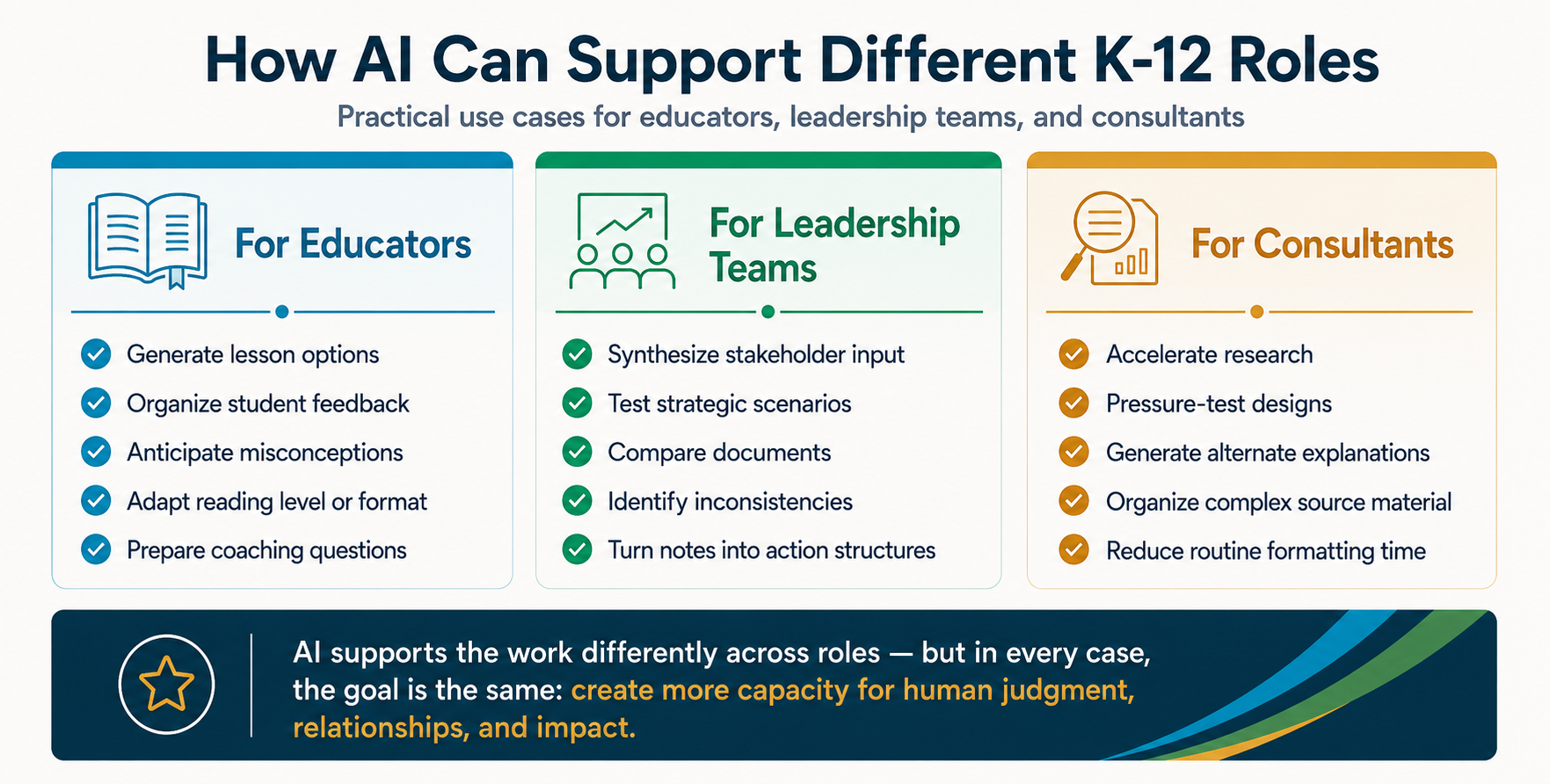
The value is not simply that the task becomes faster. The value emerges when the time and attention created by AI are reinvested in better thinking, stronger relationships, more responsive service and more consequential work.
From Scattered Experimentation to Shared Practice
Many organizations currently have pockets of impressive AI use. One person has developed an effective workflow. Another has discovered a reliable prompt structure. Someone else has learned where AI produces weak, generic or misleading results.
This is especially true within ALP and many of the communities we serve. Useful practices often remain isolated in pockets of excellence rather than becoming shared, inclusive and transparent organizational practice. We need to close that gap. If we do not establish clearer norms and routines now, the accelerating pace of technological change will make deliberate governance increasingly difficult.
ALP’s internal work has identified the need for a more purposeful and consistent approach—one that addresses quality, brand coherence, privacy, professional judgment and the risk of generic or unguided AI use.
Our emerging framework and toolkit will therefore be built from actual practice.
We are asking colleagues to identify workflows where AI adds value, clarify the human judgment each workflow requires, document safeguards and share what they are learning. We want the eventual resource to include principles, decision supports, protocols and practical examples—not simply an aspirational statement.
It should evolve as the technology and our practice evolve.
An Opening Question, Not a Final Answer
ALP does not have a finished formula for HI + AI—and we do not expect the work ever to be permanently finished.
A credible framework should be shaped by the people doing the work and by the communities affected by it. It should be specific enough to guide practice, yet adaptable enough to respect different roles, settings and responsibilities.
We are beginning with one question:
What should humans always own—even when AI can do part of the work?
For educators, that may include the relationship with the learner. For leaders, it may include the responsibility to make and explain consequential decisions. For students, it may include the productive struggle required to develop understanding. For organizations, it may include purpose, culture and accountability.
We invite educators, leaders, students, researchers and partners to help us sharpen the answer.
Where has AI meaningfully expanded your capacity? Where have you seen automation weaken judgment, agency or connection? And what work should remain distinctly and intentionally human?
Because the future of AI in education should not be defined only by what machines become capable of doing. It should be defined by what human beings decide is worth preserving, strengthening and becoming.
