

Instructional Coaches (ICs) and Instructional Technology Coaches (ITCs) are agents of school improvement and must continually invest in their own professional development to maximize their impact. When operating most effectively, these coaches build teacher capacity and activate change that impacts student success. With so much potential for growth and learning IC and ITC coaches should be engaged in their own deep learning communities facilitated by an effective coach.
The Dual Role: Input and Output
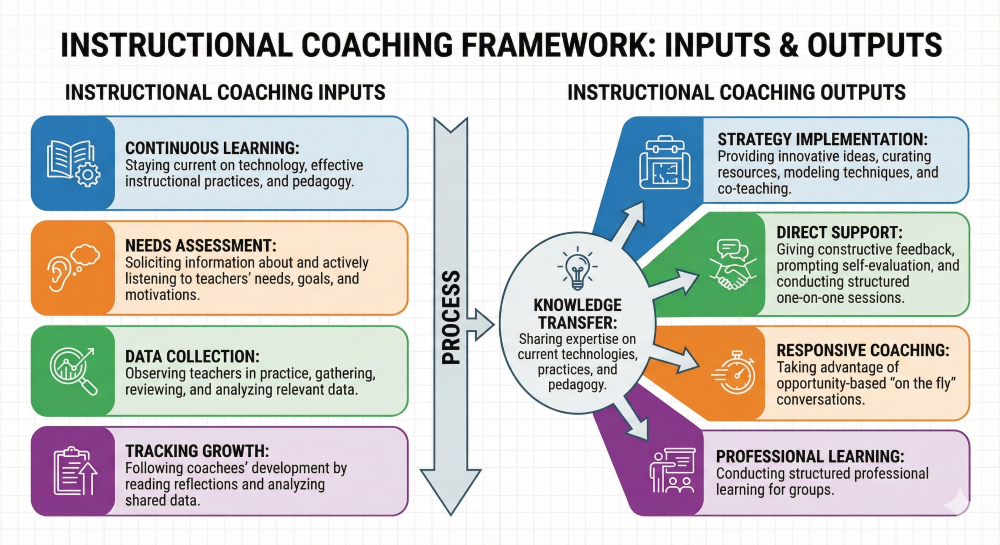
The IC/ITC role is a dynamic balance of inputs—where information is taken in, learning is continuous, and foundational knowledge is strengthened—and outputs—where that knowledge is actively shared in various settings and used to support others in their work.
Instructional Coaching Inputs:
- Continuous Learning: Staying current on technology, effective instructional practices, and pedagogy.
- Needs Assessment: Soliciting information about and actively listening to teachers’ needs, goals, and motivations for seeking coaching.
- Data Collection: Observing teachers in practice, gathering, reviewing, and analyzing relevant data.
- Tracking Growth: Following coachees’ development by reading their reflections and analyzing shared data.
Instructional Coaching Outputs:
- Knowledge Transfer: Sharing expertise on current technologies, practices, and pedagogy.
- Strategy Implementation: Providing innovative ideas, curating resources, modeling techniques, and co-teaching.
- Direct Support: Giving constructive feedback, prompting self-evaluation, and conducting structured one-on-one coaching sessions.
- Responsive Coaching: Taking advantage of opportunity-based “on the fly” coaching conversations.
- Professional Learning: Conducting structured professional learning for groups.
 Intake and output demand a high level of skill, expertise, and time. It may seem that there isn’t room for more; however, coaches—more than anyone—must know and value the importance of being coached. Somewhere in between the daily balancing of input and output, coaches need dedicated time to participate in coaching sessions of their own, where they are the coachees benefiting from the guidance and structure of a professional coach and, as we will discuss, a small group of coaching colleagues.
Balancing Input and Output: Small Group Coaching as the Fulcrum
If we think of the coaching inputs as outputs as a see saw, then we can think of the in-between point, or fulcrum upon which the dual roles are balanced, as coaching for coaches. Small group coaching for ICs/ITCs creates collaborative teams that refine practice and develop a professional learning community.
In alignment with the ISTE Standards for Coaches, coaches are Connected Learners who benefit immensely from Professional Learning Network (PLN) participation and from identifying structured ways to improve their coaching practice. Having a coach of their own to lead small group sessions in learning, reflection, and role-aligned best practices directly supports this standard.
There are multiple ways that small group coaching benefits instructional coaches:
Strengthening the Coaching Role
Small group collaboration offers an ideal setting for experience sharing and resource sharing, especially for coaches who lack regular opportunities to collaborate with others in their role
- Experience Sharing: Hearing how colleagues approach their work, engage with others, and problem-solve helps coaches to define their own coaching philosophies, styles, and core beliefs about how to best help others grow and succeed.
- Resource Sharing: Coaches can collectively add to their “toolbox” of strategies, techniques, and material, to support and enrich their individual practice.
Spending dedicated time focusing on best practices also helps to clarify the definition and scope of the role, including what it is not. Coaches are not there simply to assist with administrative tasks or be another adult in the room; they are present to help teachers improve their practice and thereby positively impact student learning. The coach-teacher relationship should remain an active, involved collaboration.
While coaches regularly help teachers clarify professional goals, coaches themselves benefit from dedicated time and guidance to advance their own professional goals.
Skill Practice Through Role Playing
A significant increase in confidence and comfort level stems from practice. Coaches who want to implement new question stems or conversational techniques can benefit from trying them out first with each other in a low-stakes setting. Jim Knight, founding senior partner of the Instructional Coaching Group (ICG), emphasizes this need:
“Too often, we assume that people know how to ask questions and how to listen. It’s surprising how frequently most of us struggle with these two skills, given how often we do them. To be effective peer coaches, teachers need to spend time learning and practicing how to ask questions and how to truly listen.” (Knight, The Four Pillars of Peers Instructional Coaching 10/1/2025)
Role playing in a small-group setting provides both the time Knight mentions and the context of a scenario, allowing coaches to refine their essential skills and find approaches that resonate and feel authentic.
Sharpening Feedback Skills
A core responsibility for coaches is providing feedback. Those who are coaching the coaches can focus on the different ways to deliver feedback and allow for practice. As ALP Senior Partnerships Consultant, Janelle McLaughlin, notes in The Power of Feedback: Growing Together Through Giving and Receiving, “Like any skill, giving and receiving feedback takes practice.” While Institutes provide a rich practice ground for feedback techniques, smaller groups benefit as well. Small groups provide the ideal setting to practice giving feedback and to learn what is proving effective for others. The smaller size (typically 3–6 people) guarantees that every coach gets adequate “air time” to practice new techniques and immediately receive targeted, specific feedback from a smaller audience.
Goal Setting
While coaches regularly help teachers clarify professional goals, coaches themselves benefit from dedicated time and guidance to advance their own professional goals. Goal-setting structures, such as Jim Knight’s PEERS goals (Powerful, Easy, Emotionally compelling, Reachable, Student-focused), can apply directly to coaches’ work and then be shared as a powerful framework for the teachers they support.
In a small group session, goal setting becomes a collective experience, offering shared wisdom and diverse perspectives. Colleagues can offer constructive feedback on the goal, suggest different strategies for overcoming anticipated challenges, and celebrate incremental successes. This all leads to more robust, well-vetted, and achievable goals. This peer support for goal setting can also offer a level of accountability and incentive that can lead to successful goal completion.
Dedicated Reflection Time
Small group coaching should build in time for individual reflection as well as reflection that can be shared among group members. Reflection is invaluable because it is the vehicle through which coaches evaluate their practice and make decisions about where to improve and identifying success. It fosters a feeling of accomplishment in achievement and allows for deeper thought about goals and ways to achieve them.
While instructional coaches consistently encourage and support their coachees to reflect, finding dedicated time for their own reflection can be difficult. Taking part in coaching sessions is a way to remain accountable and ensure that reflection happens. These reflections, having clarified areas of success, concern, ideas, or inspirations, then become a robust basis for future coaching and development.
Coaching ensures reflection happens, enabling the transformation of insights into a robust basis for future development.
The Essential Investment: Coaching the Coach
Instructional Coaches and Instructional Technology Coaches operate in a demanding environment that requires constant investment in their expertise. While their primary focus is on the crucial output of supporting teachers, they also need to focus on continuous input for their own growth. Small group coaching serves as the essential fulcrum, providing a structured, supportive, and collaborative professional learning community. By practicing key skills like role-playing and feedback, setting personal goals, and dedicating time for reflection, coaching group participants can solidify their roles, enhance their confidence, and ensure they are using the most effective, research-backed practices. This vital investment in their own development is more than a benefit; it is a necessity that ultimately equips coaches to maximize their impact on teacher capacity and, consequently, on student achievement.
ALP’s coaching approach is designed to provide targeted support, clear goals, and a structured process for individuals and teams to achieve their objectives. Contact us to learn more about coaching for your district.
Christine Sachs brings more than two decades of experience, an M.S. in Foundations and Teaching, and a B.A. in Education to her practice. Driven by a mission to empower and inspire, she believes that educators thrive best within supportive communities. Christine is passionate about collaboratively building innovative learning environments that lead to tangible student success.
